- mantis nine nines
As a man-child whose proclivity for toy robots is well known among family and friends, I face a dilemma this time of year. My wife, my kids, my mom, everyone wants to share my passion and get me "the one you've been looking for" as a holiday gift. Despite years of telling them not to bother I have learned they will just hit Target and scoop up a movie Bumblebee or something similar that is bound for the donation box. Not that there is anything wrong with donations, but my family wants to see their bot on display and know they were able to show they get ME.
We can all relate, I'm sure. I've been on the other end perusing Magic the Gathering cards or Skateboard gear for my nephews, yarn and crochet needles for my sister, books about vintage revolvers for my brother, with only the most casual understanding of what I'm looking at but determined to not be THAT GUY and give another gift card this year.
With that in mind, I wanted to celebrate the season by looking at how different our experiences can be with this issue, and end with a few tips for those still struggling with how to best balance their fandom and their loved ones generosity. I asked a few people from around the community to share their stories.
Rob Clay
I've been on both sides of the "Collectors Are Hard to Shop For" coin. When I was young and wanted to be surprised more than anything, I'd spend a day or two making up a detailed wishlist for me and my brother to give to our relatives. The first year, I had to reassure my appalled aunt that we didn't expect EVERYTHING on the list. (This all started in 1992, when I got a very expensive copy of Sonic the Hedgehog 2 for Christmas, which I knew in advance, and my brother got the entire Incredible Crash Dummies toyline and G2 Optimus Prime, which were all on sale. Sonic 2's a good game, but that was kind of a bummer of a Christmas morning.) A few years later, we tried to get something my uncle, a model train collector, would like - and missed the mark pretty hard. He didn't say so, of course, but you can tell. We've probably all forced that smile at least once in our lives.
We collectors can be miserable to shop for! There's so much merchandise surrounding any hobby that there is a super-narrow stripe of success stuck between "not quite the right thing" and "already own." Over my life I've known a fair number of people who simply ask their spouses "Would you get me this for Christmas?" Or even just say "I'm getting this as my Christmas present." The longer I'm around the more I understand the wisdom of it. Even the people closest to me have trouble knowing exactly what's right for me unless I tell them exactly what to look for. And if you spend a lot of time talking to other collectors with similar interests online, it can be easy to lose track of how personal and specific a collection really is.
These days, most of my relatives just hand out money because they're too old to deal with the shopping thing. I still buy stuff for my closest family members - the ones I live with, because it's easier to keep up with their collections if I pay attention. I largely bake cookies for the rest of the family and put them in pretty tins. It's hard to go wrong with homemade cookies! (Assuming you know everybody's dietary habits and allergies!) I keep an Amazon wishlist for online friends to use, which is pretty similar to the ones I used to hand out to my family, really. On those few occasions when the family wants to do something more specific for me, I pick one thing I want that's in their price range, with maybe a backup if it's sold out. (I'm pretty sure I'm getting Titans Return Blaster this year - it'll be the first time I've opened a Transformer on Christmas in probably 20-plus years. I'm excited!)
Drew Merkel
Honestly my family pays little attention to my collection, so they don’t know what I have. I’ve convinced a few to get gift cards. My dad on the other hand still thinks he’s pretty cool and tries to buy me stuff. I’m the proud owner of an R.I.D titan Bumblebee MISB that I will never have the heart to sell.
Ben Watson
I shan't keep you from the words of the rest of our excellent guest contributors for long but felt the need to chime in on Dan's subject as it's currently something that's been on my mind. Christmas for me now means "buying myself Transformers". I can't fathom a Crimbo without these bloody things, now having just about 20 solid years of them taking up residence under my tree every December. Somewhere along the line I came to the conclusion that the holiday isn't complete if I'm not cracking open some cool robos. So now that my collecting is well and truly beyond the grasp of my family, even with my dad's best efforts to keep up I've now phased into becoming my own Santa in some unspoken way. Along the course of the last month I've accrued all of those bots you see above, purely for this purpose. I genuinely miss the surprise. I'll cite 2015 and unwrapping CW Silverbolt as the last bit of that I've had but it's not all bad as that feeling becomes reserved for completely different gifts, the likes of which you wouldn't buy yourself during the rest of the year. I'm expecting a random assortment of Star Wars guys this Yule and am actually excited to see which space weirdos my old pa has picked out for me. I guess in this way, while I want to keep the occasion an opportunity for a good haul, there's really very little of the Christmas spirit coming from Transformers for me now. Maybe next year I'll go cold turkey - and I'm not just talking about sandwiches on Boxing Day.
Erica Walsh
Oah! It's Christmas! I'm Jewish! No but genuinely, I love this holiday despite no religious attachment as I'm sure so many others in this community do, and NOT just because of getting toys! Frankly, I don't get toys for Christmas anymore, despite having the time where I would receive them pretty close in my rear-view. Christmas-time is a bit of a weird one for me and my family, to be honest. Being as it's not really FOR most of us, my family isn't really 100% invested to begin with – aside from me, of course. To be honest, I'd hazard a guess that the decorations and such only go up at my own behest anymore (and because I'm usually the one putting them up at all). As such, gift-giving in my household has almost felt more like an obligation than a genuine attempt at goodwill. Now I'm still a fairly young lass; being considered a kid is still pretty recent in my memory, so the gifts have been getting more mundane as the years go on – which is okay! It still surprises me how often I find myself without a guaranteed matching pair of socks. But, I've took notice of a sort of “Christmas Sweet-Spot” common amongst adult collectors where, at a certain point, our loved ones become at peace with the fact that we love children's playthings and it makes their holiday shopping that much more simple (or difficult, depending on our specific toyetic tastes). Being an old soul of Twenty Years Old, I don't think I've reached that spot just yet, but that's alright too. I love this time of year enough that even when my parents, siblings and loved ones only feel comfortable buying me gaudy jumpers and 12-packs of underwear, I'm still pretty stoked to get anything at all. Besides, being a Proper Grown-Up has its upsides – the toys I don't get from Mum and Dad anymore? I can just buy them for myself, while coming to a sobering realisation of what a horrible drain of cash and resources Little Erica must've been.
Swage66
I have made it a bit of a known “rule” that Transformers-related merchandise is
probably
not the route to go in terms of gift-giving. A few times, the rule has
been ignored but many frosty nights have gone by since the last
occurrence. As any gift is truly appreciated, I certainly didn’t object
or refuse, but it did leave something similar to a guilty feeling in me
when it happened. I think as you become a collector of specific tastes
within the spacious confines of a “brand” it’s hard to REALLY enjoy
something as the sender intends you to, when they generally have no idea
what it is you are focused on. Online-only availability, various types
of product names that look like gibberish, and pricing in general can
leave an outsider of the hobby completely baffled. Worse, buying things
on the aftermarket by not knowing the better sources. While I’ve never
gone overboard as far as spending, and I seem to have a good eye for
that “perfect” gift, I can honestly say that collecting Transformers at
the level I do is the real catalyst for many of these gift-giving
miracles. I’ve always enjoyed Christmas, and all the habits and tactics I use to collect Transformers are a SERIOUS advantage when I start shopping for family. Whether
it’s finding a cheaper source, better selection, or a bigger/better
version of something that catches my eye - it all comes together
seamlessly using the same approach as trying to find something for
myself. But it’s WAY better, because I get to see and hear the joy that
special find brings in someone else I love! Even better - or worse - is
when I find that PERFECT trinket. I spend a good amount of time letting
everyone know that a pants-shitting-level of astonishment is headed
their way. (But remember, you gotta actually bring the heat if you go
this route.)
That rush of finding a good deal, or winning an auction you thought you had no chance at? I
would
say is about 100 times better when someone has no clue about the amount
of random goodness you are going to hand them.
This is what my family deals with EVERY year - a crazed, deal-hungry, gift-giving master - who just really wants new socks and a monthly calendar.
Hello, Dan again. So what do you think? Did these essays sound familiar? I'm sure some of you are reading this surrounded by friends and family, biding your time until you open that Deluxe Bayformer and fake a smile. Hopefully you can find comfort knowing you're not alone! And for those not celebrating the season I'm sure you encounter the same problem in any gift-giving situation.
Tips for collectors:
1) Make a list (be specific). It takes the surprise out of it but it ensures a gift both sides will be happy about.
2) Learn to leave wave 1. That preholiday restock is unpredictable but almost always features tons of bots we rushed to get and then watched shelfwarm. Friends and Family love to scoop up a nice retail bot, why not skip a few you're iffy on and see if you get lucky.
3) Think outside the box. Gifts are a great chance to try something new, why not ask for an RID bot or Marvel Legend, something from a line you don't collect. Maybe get hooked on another addictive variety of Plastic Crack..
4) Socks. Or undies, or other necessities that will save your funds for the fun stuff!
5) Charity. The most important message I can send is to put aside selfish motivation and think about all those kids out there who will get nothing for Christmas. Your donation to Toys for Tots or any other church or charity could be their only present. Put that toy expertise to work and hook them up! Imagine how stoked any child would be with a sweet transforming robot picked out by a true collector!
However you celebrate, I hope your holidays are #Refined
Follow Rob Clay on Twitter @rac2750 YouTube (as Flail Throughs)
Follow Erica on Twitter @TransSoundwave
Follow Swage on Twitter @ReeledRobot
Follow Drew Merkel on Twitter @DrewsiferxXx and @Close_Countach
Follow Dan on Twitter @mantisninenines
Wednesday, 20 December 2017
Wednesday, 13 December 2017
Toy customisation. Play, Exploration and Experimentation
- Leigh Gregurke
That act of exploration is one of the most engaging elements of customisation for me. It provides another level of examination and inspection that you don't get sitting them on a shelf. Customising teaches you about surface texture, detail, hidden and obtuse information and its relationship with presented information, construction, texture and material. It can be a method to further enjoy something you already like on a deeper level or a way of building an appreciation of something you initially were indifferent to.
Customisation of toys for me is another form of 'play'. Rarely do I plan too hard nor do I have something in mind when I start, more often than not its a process of action and reaction, ongoing experiments that give me a chance to to discover a figure.
One of those bots that I just bounced off of was the newer leader seeker mould. I picked one up for clearance price but it still just didn't grab me. The plastic quality, the light feel, the surface detail lost in the gloss plastic finish. I didn't spend much and because it had gone almost straight form box to shelf I knew a custom job might give me some value exploring the figure.
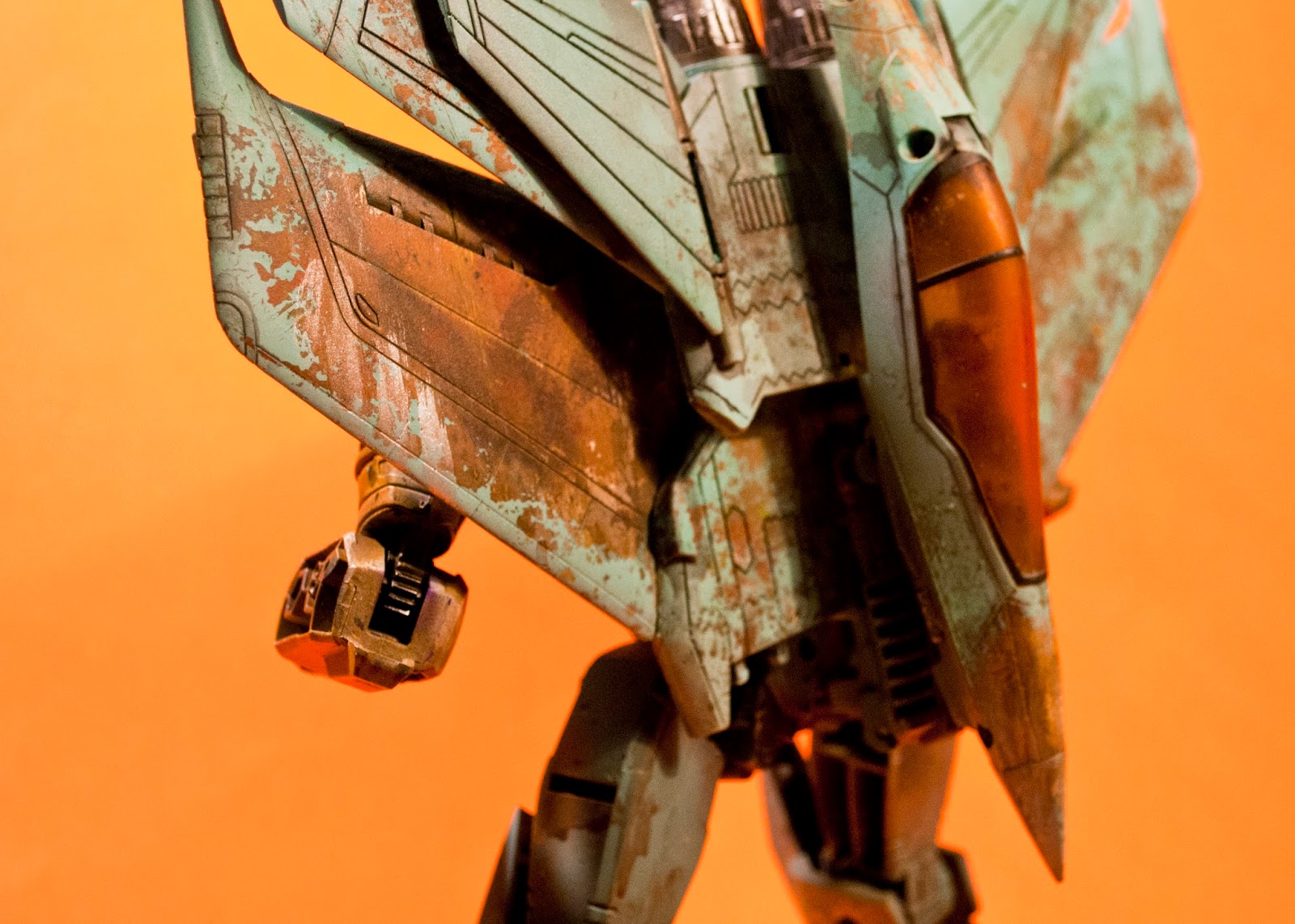
I had recently been experimenting with some new techniques and I wanted to share some of that process. Using salt, hairspray and layered paint the technique creates realistic looking paint chipping effects. My only goal was to create something worn, chipped and rusty looking with an interesting colour palette removed from traditional seeker designs.
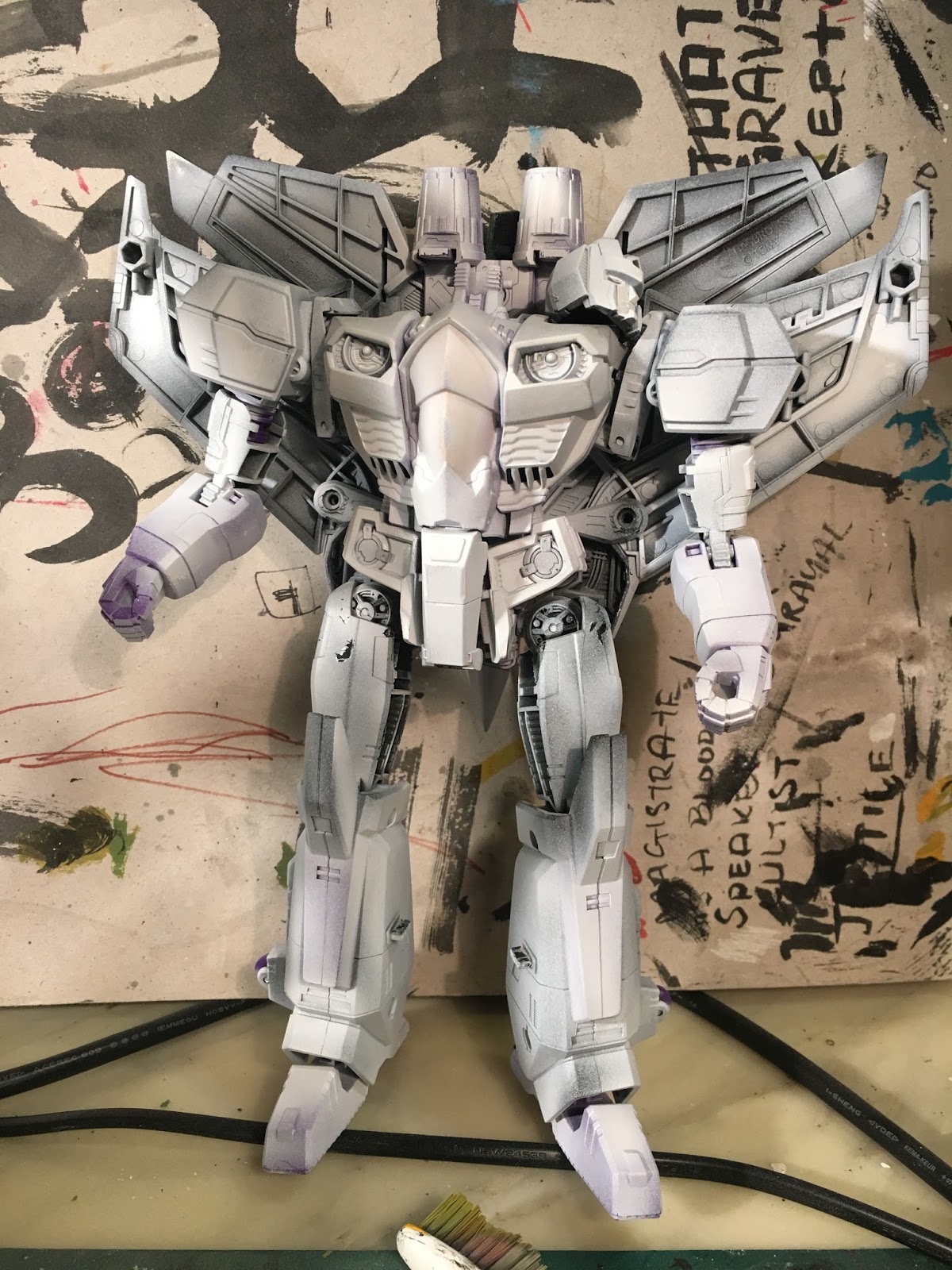
I started with this.
And ended up with this.
Here is how I got there.
PREPARATION AND PRIMER
Normally I would consider taking a figure apart to paint separate pieces but in this case I only removed the head and small clear plastic part to paint separately. To ensure the paint would adhere I first gave the figure a quick clean, dry and then a light and quick sand. I then undercoated with a layer of Tamiya white liquid primer applied with an air-brush.
The airbrush gives you a nice even and thin coat, a spray can gives a similar result but depending on temperature and humidity can be a little harder to control. Acrylic auto primers can be purchased for a cheap price and work well. Wanting a rough looking finished product I wasn't concerned with shaving down panel lines or a perfectly even primer coat.
RUST TONES
They key to successful rust effects for this method is the initial paint layer. It is important to consider the underlying colour and texture you intend to appear under your main body colour. I wanted a rich brown rust colour so I started by applying thin and rough layers of a range of acrylic browns with an airbrush.
I find the key to good accuracy is using a source. I took a number of photos of objects that had the surface colour and texture I hoped to capture that I could draw upon.
For the rust coat I employed colours from both Privateer Press's P3 range and Vallejo paints. Both acrylic thinned with a window cleaning solution (alcohol and water). Once dried shadows, some more silver metallic tones and a number of washes were applied to give more depth and a less uniform approach. I found spraying through old pieces of cloth, foam and organic objects helped avoid anything too unnatural looking. It is vital to consider the scale of your mark making, a brush stroke mark will look like a brush stroke immediately ruin the illusion of scale.
HAIRSPRAY AND SALT
The method uses a very simple idea. By applying a texture to the surface that is bonded temporarily you can spray over it, then remove the texture mask revealing the original colour underneath. The method is further assisted as the bonding agent used is hairspray which when brushed with water activates and can be removed leaving behind streaks and residue depending on the pressure applied.
With a very cheap can of hairspray I coat the areas quite liberally that I want to apply my salt texture to. I find coarse rock salt that has been smashed with some pieces ground finely works best as the pieces are no longer uniform, a range of sizes is ideal. Sprinkling them over the wet hair spray surfaces and left to dry they eventually turn white and become bonded to the surface. Depending on the humidity and temperature of your environment employing a hair dryer on a low setting may speed up the process.
In regards to placement, I like to draw back on realistic sources. In some cases chipping, rust and wear and tear is evident in frequently used surfaces such as handles and hinges. For this piece I wanted something that had its major surface areas slowly eroded by rain that might pool on flat areas and the slow spreading erosion caused by a lack of use and exposure to the elements.
The next step involves masking or removing any areas you don't wish painted with your main colour and then painting your primary body colour. With the burnt orange tone I had with my rust I wanted to find a hue that provided enough contrast but also complimented my warm scheme so I mixed up this turquoise tone with a range of different acrylics.
Sprayed on again with an airbrush (this time at a lower pressure as to not remove the salt material) I made a number of thin coats slowly building up layers. In the cases where the brush did remove some salt material its not something for major concern as it actually provides a nice medium between the flat colour and the base layer.
SALT REMOVAL
Once the body colour had time to to dry I started with a stiff bristled brush and old tooth brush to remove the salt exposing the base tone underneath. Due to the effect I I desired I was not bothered if it came out a little rough and I was happy to experiment with the process. An organic pattern was important so I tried to avoid any deliberate marks that looked out of scale.
I found that the effect had not created large enough spots of wear so applying some water and pressure with my brush I pushed away further paint exposing more areas and also focusing on areas where extra wear might be apparent. The hairspray layer while fixed currently can be activated with water, this means that the layer of turquoise paint can be further removed, thinned or chipped just by wetting the brush in the process.
FINAL DETAILING AND PROTECTIVE COAT
I didn't want to overwork or detail this project so I utilised only a small amount of Tamiya panel liner to touch up a few further details including reclaiming some panel lines that had been visually lost in the paint.
To keep with the dry, old and weathered appearance I used a dull-coat on this figure. There are a number of brands but I personally rate the effect of Testors dull-coat. A few light mist coats followed by a heaver layer once dry also gives a level of protection against wear and tear and some of the rigours of transformation. I purposely did not mask the cockpit transparent plastic when I applied the dull-coat to give the appearance of frosted glass from years of dust and micro scratches in the wind.
FINAL THOUGHTS
I did not set out with a great plan other than to experiment with a technique and play with interesting colour palettes. Not locking myself into creating a certain colour that matches a character gives a certain freedom that is rarely felt in a hobby that often gravitates towards prescribed character palletes and appearances.
I think what I enjoyed most was the chance to spend time with a figure I had mostly ignored. I developed a great appreciation for the surface detail and and information that went hidden, obscured by the reflective shiny plastic. Throughout the process I learned just how brilliant the jet mode is, its shapes hide the 'robot under a jet' with some success and just covered in wonderful striking mechanical angles and lines. If I hadn't undertaken this experiment I don't think this toy would have ever come off my shelf.
I am glad it did.
To finish, here are some more images of the finished product.
As always, keep it #refined
That act of exploration is one of the most engaging elements of customisation for me. It provides another level of examination and inspection that you don't get sitting them on a shelf. Customising teaches you about surface texture, detail, hidden and obtuse information and its relationship with presented information, construction, texture and material. It can be a method to further enjoy something you already like on a deeper level or a way of building an appreciation of something you initially were indifferent to.
Customisation of toys for me is another form of 'play'. Rarely do I plan too hard nor do I have something in mind when I start, more often than not its a process of action and reaction, ongoing experiments that give me a chance to to discover a figure.
One of those bots that I just bounced off of was the newer leader seeker mould. I picked one up for clearance price but it still just didn't grab me. The plastic quality, the light feel, the surface detail lost in the gloss plastic finish. I didn't spend much and because it had gone almost straight form box to shelf I knew a custom job might give me some value exploring the figure.
I had recently been experimenting with some new techniques and I wanted to share some of that process. Using salt, hairspray and layered paint the technique creates realistic looking paint chipping effects. My only goal was to create something worn, chipped and rusty looking with an interesting colour palette removed from traditional seeker designs.
I started with this.
And ended up with this.
Here is how I got there.
Normally I would consider taking a figure apart to paint separate pieces but in this case I only removed the head and small clear plastic part to paint separately. To ensure the paint would adhere I first gave the figure a quick clean, dry and then a light and quick sand. I then undercoated with a layer of Tamiya white liquid primer applied with an air-brush.
The airbrush gives you a nice even and thin coat, a spray can gives a similar result but depending on temperature and humidity can be a little harder to control. Acrylic auto primers can be purchased for a cheap price and work well. Wanting a rough looking finished product I wasn't concerned with shaving down panel lines or a perfectly even primer coat.
RUST TONES
They key to successful rust effects for this method is the initial paint layer. It is important to consider the underlying colour and texture you intend to appear under your main body colour. I wanted a rich brown rust colour so I started by applying thin and rough layers of a range of acrylic browns with an airbrush.
I find the key to good accuracy is using a source. I took a number of photos of objects that had the surface colour and texture I hoped to capture that I could draw upon.
For the rust coat I employed colours from both Privateer Press's P3 range and Vallejo paints. Both acrylic thinned with a window cleaning solution (alcohol and water). Once dried shadows, some more silver metallic tones and a number of washes were applied to give more depth and a less uniform approach. I found spraying through old pieces of cloth, foam and organic objects helped avoid anything too unnatural looking. It is vital to consider the scale of your mark making, a brush stroke mark will look like a brush stroke immediately ruin the illusion of scale.
HAIRSPRAY AND SALT
The method uses a very simple idea. By applying a texture to the surface that is bonded temporarily you can spray over it, then remove the texture mask revealing the original colour underneath. The method is further assisted as the bonding agent used is hairspray which when brushed with water activates and can be removed leaving behind streaks and residue depending on the pressure applied.
With a very cheap can of hairspray I coat the areas quite liberally that I want to apply my salt texture to. I find coarse rock salt that has been smashed with some pieces ground finely works best as the pieces are no longer uniform, a range of sizes is ideal. Sprinkling them over the wet hair spray surfaces and left to dry they eventually turn white and become bonded to the surface. Depending on the humidity and temperature of your environment employing a hair dryer on a low setting may speed up the process.
In regards to placement, I like to draw back on realistic sources. In some cases chipping, rust and wear and tear is evident in frequently used surfaces such as handles and hinges. For this piece I wanted something that had its major surface areas slowly eroded by rain that might pool on flat areas and the slow spreading erosion caused by a lack of use and exposure to the elements.
The next step involves masking or removing any areas you don't wish painted with your main colour and then painting your primary body colour. With the burnt orange tone I had with my rust I wanted to find a hue that provided enough contrast but also complimented my warm scheme so I mixed up this turquoise tone with a range of different acrylics.
Sprayed on again with an airbrush (this time at a lower pressure as to not remove the salt material) I made a number of thin coats slowly building up layers. In the cases where the brush did remove some salt material its not something for major concern as it actually provides a nice medium between the flat colour and the base layer.
SALT REMOVAL
Once the body colour had time to to dry I started with a stiff bristled brush and old tooth brush to remove the salt exposing the base tone underneath. Due to the effect I I desired I was not bothered if it came out a little rough and I was happy to experiment with the process. An organic pattern was important so I tried to avoid any deliberate marks that looked out of scale.
I found that the effect had not created large enough spots of wear so applying some water and pressure with my brush I pushed away further paint exposing more areas and also focusing on areas where extra wear might be apparent. The hairspray layer while fixed currently can be activated with water, this means that the layer of turquoise paint can be further removed, thinned or chipped just by wetting the brush in the process.
FINAL DETAILING AND PROTECTIVE COAT
I didn't want to overwork or detail this project so I utilised only a small amount of Tamiya panel liner to touch up a few further details including reclaiming some panel lines that had been visually lost in the paint.
To keep with the dry, old and weathered appearance I used a dull-coat on this figure. There are a number of brands but I personally rate the effect of Testors dull-coat. A few light mist coats followed by a heaver layer once dry also gives a level of protection against wear and tear and some of the rigours of transformation. I purposely did not mask the cockpit transparent plastic when I applied the dull-coat to give the appearance of frosted glass from years of dust and micro scratches in the wind.
FINAL THOUGHTS
I did not set out with a great plan other than to experiment with a technique and play with interesting colour palettes. Not locking myself into creating a certain colour that matches a character gives a certain freedom that is rarely felt in a hobby that often gravitates towards prescribed character palletes and appearances.
I think what I enjoyed most was the chance to spend time with a figure I had mostly ignored. I developed a great appreciation for the surface detail and and information that went hidden, obscured by the reflective shiny plastic. Throughout the process I learned just how brilliant the jet mode is, its shapes hide the 'robot under a jet' with some success and just covered in wonderful striking mechanical angles and lines. If I hadn't undertaken this experiment I don't think this toy would have ever come off my shelf.
I am glad it did.
To finish, here are some more images of the finished product.
As always, keep it #refined
Thursday, 30 November 2017
Further Transformation of Masterpiece Transformers
- Dorian MacQuarrie
Recently Ben wrote about his thoughts on the Masterpiece line, largely revolving around just how special MP toys feel when you have whole shelves of them and some months ago I also wrote about the direction of the Masterpiece line and the focus on cartoon accuracy. It seems the line is going through yet another transition as Takara once again move the goal posts to keep the MP line fresh, taking it from the realms of a premium Transformers product, grounded in the expectations of that particular brand, to something much more akin with 'adult collectable' lines such as Soul of Chogokin, SH Figuarts and the like.
From it's relaunch with MP-10, Masterpiece toys were fairly priced, above mainline pricing sure, but still a reasonable purchase for your average collector. With the Hasui cars floating around the same price as a Leader class toy it was probably more a question of bang for your perceived buck than if one could afford an MP toy or not. I say perceived as even now collectors tend to assess price based on size first and other factors such as engineering and accessories later. What amounted to a more complex Voyager toy for around $60 can seem like a poor deal for some people. Regardless of the perception of cost vs content, most MP toys felt quite affordable and even MP 10 could still be achieved with a little saving and forethought. Today, that is definitely no longer the case. What MP Shockwave and Inferno started, Megatron, the upcoming Sunstreaker and the recently revealed Dinobot have continued. Price is going up and up, well beyond what the size of the toys would indicate, a poor measure to judge a toy as just mentioned but still an initial reaction for most collectors. When compared to their Third Party counterparts, Takara are now the more expensive option, an interesting flip on the previous narrative of 3P vs Official.
The increase in price does not come without a boon though, we have seen a dramatic increase in accessories, parts count, paint and quality of transformation. MP Prowl came with his gun and maybe missile launchers if you ordered from certain retailers and that's it. MP Inferno on the other hand has alternate heads, faces, alt mode parts, episode specific accessories and more. Whether you think these are worth your time or not doesn't change the fact that the higher price does get you more. While Takara are still yet to achieve the perfect paint job which can survive the transformation process, the finish these recent MP toys have is absolutely gorgeous. I never knew I wanted paint on my toys beyond a few details until I opened up MP Inferno and realised just how much difference a well done, vibrant and glossy finish makes. By comparison the early MP releases feel and look far more toy like, expensive toys sure but still toys - a coat of paint with an attractive finish elevates these releases to a much more 'adult collectable' niche. With the ever rising amounts of 3PMP which are themselves often seen as 'adult collectables', it seems that Takara are taking the Masterpiece line in a new direction no Third Party company has yet to successfully compete on: high levels of paint, parts and truly jaw dropping transformations, complete with that 'Masterpiece Moment'.
What exactly makes something an 'adult collectable' is up for debate, and it's not one I'll be taking part in today but what we can do is look at other toy lines, purely aimed at adult collectors with the extra spending power often associated. From the more run of the mill SH Figuarts and Figma toys to the top tier Soul of Chogokin and frankly ludicrous Macross releases from Yamato, there is plenty on offer for the discerning collector who wants the best. The best build, the best paint, the best accessories, the best toys. Until recently Masterpiece Transformers were not considered to be in this bracket. They were high end toys but only relative to the mainlines produced by Hasbro and Takara and certainly not 'adult collectables' the likes of which I previously mentioned. The most high flying MP collector, Third Party or otherwise could be considered chump change to those who would have a set of Yamato Valkyries. Takara are taking the MP line into new territory, to a place where $200+ is a common price point and not necessarily because it's a 12" transforming robot full of die-cast but rather because it's an 8", full plastic toy with an advanced transformation, requiring far more parts than what we have seen before and of course, covered in luscious paint applications. I have seen enough gnashing of teeth across the internet to know this is uncomfortable for a lot of collectors and it certainly has me putting more thought into future purchases but I do not see this as a bad decision.
To echo Ben's thoughts from his previous article, the MP line was at risk of being normalised, of becoming a mainline-plus of sorts for those who had the money to drop on what would amount to a $60 Voyager but with this new direction from Takara it has once again been elevated to the pinnacle of modern Transformers collecting and each purchase feels like a big deal, like it's something special. When I finally get my hands on MP Sunstreaker it won't just be another Autobot car, it will be a wondrous experience with what I hope is an inventive transformation and a lush presentation and that the higher price of nearly double that of his brother Sideswipe comes with all the advances and innovations Takara have developed since the release of the red Lambo.
Of course, all these advances, add ons and developments come at that extra price which has divided many collectors and when MP Dinobot will cost the same as Fanstoys Jetfire, you have to wonder if maybe someone at the pricing department made a mistake. From preview pictures we can already determine just how complex Dinobot is going to be to achieve that incredible bot mode and again, the toy will be covered in paint for the purpose of screen accuracy. This all costs money and you don't get better toys for the same price as their predecessors, be it due to time spent in further development or just more resources (tooling, build time, paint applications) put into the construction process. I imagine some people would rather pay less and get less overall, that extra faces and odd accessories which drive up the cost could happily be cast aside if it meant a reduction in price. Honestly, I'm one of them and I'd rather MP Inferno was a little cheaper and not come with all those damned accessories, you know "from that one time in that one episode". But it must be said that the developments we have seen in transformation, finish and presentation speak for themselves and have successfully drawn me right back into the Masterpiece line when in fact I felt my interest was waning due to the shift in aesthetic.
I do not think this change in the Masterpiece line is due to Third Party releases, rather I think it's just the natural evolution of a toyline that's pushing nearly a decade in it's current incarnation. I cannot say how much of a problem Hasbro and Takara view theThird Party scene but it does seem that rather than continue to produce a product which will invariably be aped by a range of companies, they are changing the scene altogether. They themselves will set the standard, they will decide what constitutes as a 'Masterpiece Transformer' and leave the Third Party scene to follow suit. This could invalidate some previous purchases as your earlier Autobot Cars look out of place next to the upcoming Sunstreaker but I doubt Hasbro and Takara would lose any sleep over the matter. It probably just means we'll be seeing a new, even more toon focused MP Prime in a few years to better match Megatron.
And on that note, keep it #Refined.
Follow Dorian on Twitter @Vigadeath
Thursday, 23 November 2017
Masterpiece Minimalism
- Ben Watson
For most of my collecting life, the Masterpiece line has been above my pay grade. Occupying a legendary higher plane of top quality and an associated dimension of exclusivity. But is this still true today? Many collectors take Masterpieces as their bread and butter and fill their boots in the way the rest of us CHUG-scrubs would with regular figures. Since the rebirth of the line ushered in by MP-10 and the first Autobot cars, releases have been frequent, bringing down some prices and opening up the line to many more collectors, but has some sheen rubbed off the Masterpiece name along the way?
Of course, don't get me wrong, the quality of the figures themselves seems to have gone from strength to strength with each new mold being a new masterclass in plastic wizardry. To those with the resources to keep up with every release this must be an unending conveyance of delights. But to those people I ask, "Is it still special?" The obtainment of a new Masterpiece should be an event, an infrequent joyous occasion, like Christmas or TFN. I still remember how huge it felt to get my hands on my first MP figure even if it was the less-than-iconic Year of the Horse Optimus Prime. I'd never thrown that amount of pennies at a toy. I'd never had such an experience of high-end design and construction. I'd never had a figure prove itself to be a masterpiece to me. Can this level of awe be sustained for so many sequential pieces?
We're now entering a phase of the line where costs seem to be beginning to rise to a point that cuts people off from the figures on offer again. To those biting their fists as they hit the pre-order button for MP Dinobot, a much larger commitment is made and hopefully will lead to a much larger payoff. You can't deny any £200~ figure is an event purchase. But are the £40~ Hasui cars or their litany of obscure repaints? Takara have certainly realised how they can maximise their gains from the MP line but you can't tell me Tigertrack was the highlight of anyone's collection so far... (Shoutout to you if it was)
In light of this saturation I've chosen to be particularly selective with my Masterpiece purchases now that I'm in a position to afford more of them. I still want each one to be a Big Deal and a memorable piece in my ever-expanding hoard for more than just inherent physical qualities. Just over half of my MP figures were picked up at conventions as a kind of core of that particular haul. My first was to mark my 21st birthday and my own way of marking Transformers' 30th. Each one is a significant and special part of my collection and I feel like if I let myself go and snap up many more, that very subtle and particular feeling would be lost and I'd receive them in the same semi-numb state as I do when bringing home mass retail figures from Tesco.
Masterpiece Transformers deserve reverence and a space upon some metaphorical plinth in your collection. With the current subtle trend towards making the line more like other high-end collector toys on offer in Japan with the incorporation of alternate faces and effect parts, the line lowers itself down just slightly from the lofty realm it once sat above in. I don't object to this paradigm shift, in fact I embrace it but it is changing what the words "Masterpiece Transformers" mean to many.
For the moment I'll continue to keep Masterpieces in my house at a minimum. The collection I do have is eclectic and not really representative of my tastes in Transformers at all but I recognise each one as their own self-contained hit of true excellence. Of course, if we were living in a time of Unicron Trilogy Masterpieces, I would be singing a completely different tune. While I see the MP line for the crowning achievement it is, it's only just starting to dabble in the character designs that really matter to me. It's very possible this is what allows me to show restraint when presented with the smorgasbord of delicacies on offer from the MP menu, but buddy if MP Armada happened tomorrow, I'd still want to take it steady and savour every dish.
Follow Ben on Twitter @Waspshot23
Friday, 17 November 2017
Borrowed Bots
- Leigh Gregurke
The Masterpiece line is getting too expensive.
I am running out of space.
I cannot keep up with these releases.
Selling things on the internet is a huge hassle.
I don't interact enough with other people in the community.
Once I play with something a few times I lose interest.
There might be a solution to these problems. It's going to raise a few eyebrows, its just a little bit socialist almost and it might also not work at all...
Borrowed Bots.
Let me set the scene.
New toys, toys from shops, toys in boxes, toys that were still mostly in one piece were always a little alien to me as a child. I grew up in a rough situation and a lot of what I had (I had a good amount still but) it came from markets, it came from garage sales, it came from school yard trades. Perhaps that was a formative experience that forged an acceptance of sticker wear, missing accessories and chewing gum wedged into joints; all those experiences led me to not be fussy about having something that was previously owned, and often curious of the chain of people who did own it.
I like a good trade, an exchange of times. As a kid to get around a lack of money I had to do a lot of the old "you can take this home for a few days, bring it back at the end of the week and you lend me something okay?" I never learned a lesson sometimes on clientele and way too may G.I.Joes came back with broken O-rings but it was an experience, a shared moment of play between friends and a show of generosity.
Can that still work in the era of hundred dollar fancy collector pieces? I think... it might?
I really wanted MP Artfire. I don't spend much still but this was an instant pre-order.
Here is the thing though, this one isn't mine, I'm borrowing it and it's just as fun and amazing and great of an experience as owning one. The one I ordered sadly was never delivered amongst a number of other orders as a highly dubious retailer burned me. The whole experience really soured me on collecting and especially forking out big bucks. One day though, a friend who is a very casual Transformer collector but observer of the field and hobby bought one and gave it to me to play with, to photograph, to experience.
Nostalgia isn't just about the plastic, the box art and the characters; The experience is part of that nostalgia and all those "hey, I know you don't have one of these, take it home and play with it" good feelings came flooding back.
It left me thinking if there was something more sustainable in this model. In a way we see the 'early release 3P' scene sharing a few test shots amongst reviewers. The situation there though is one wherein the creator is covering the cost of the item and sending it on, is there a way a group of friends could share something?
Immediately I thought of the barriers of course.
We like to keep things, we collect.
We like to finish lines, groups, toylines.
We don't always like second hand things, we like to be first to things.
How do we deal with the financial element?
Shipping costs... boo
Big barriers. Huge.
But... breaking those barriers is powerful and one of the potential windfalls of a new approach. What if... A group of friends formalizes an agreement that they offer up something they choose on a period basis to share? Maybe after a meet-up at a pub or a cheapish parcel away?
Perhaps it gets a little more formalized. A group of friends make a contribution to a larger pot and that is used for purchases? Between them they can put together a sensible discussion on where things end up.
Specifics will be very location and personality centered but I feel that discussion is part of the experience of friends coming together.
As adults I feel we struggle with asking or offering "do you want to take this home and have a play" because it sounds a little weird, however it's something so absolutely intrinsic to our hobby. I think it could really alleviate space, money, storage, rotation and regret issues. I'm not sure we really want to live in houses where every flat space is an assembled group of huddled robots (I know some do though), I am not sure we actually get much value out of something after a period of time when it becomes a static object. I want my belongings to be used and I want you to know just how much fun and amazing pieces of design they are.
This Artfire is going home soon I imagine but we had good times together. A short time I made the most of.
Thursday, 9 November 2017
Collector as Curator: Placement Context and Grouping Relationships
- Leigh Gregurke
Somewhere in the motion to not take collecting too seriously I think we distilled how we display items down to three identifiable states.
1. The shelf or display case bot
2. The desk bot
3. The storage box bot.
Inside those display options we further break the contents of the display into a similar trio of categories. Line, character and faction alignment.
What if however, by establishing these limiting categories we are restricting our own ability to see, enjoy and experience the items we collect? I wonder if that by limiting our options and engagement of how we present we are limiting our creativity and removing a portion of play and appreciation from the the process?
I don't want this article to tell you how to display your own collection - however I want to tell you how to see and think about the choices you make. This is a heavy piece of writing and it will challenge you, but I hope that you will go away thinking very differently about the way you view toys on a shelf.
1. Display context, a space's effect on the object.
Where we place an item has a profound effect on how we see and value that object. Place it in a display case and suddenly it feels precious and worthy of attention. Drop a figure on your desk and suddenly it's a 'desk bot' a fun little play piece. Store something under your bed in a plastic tub and it's out of rotation, not loathed enough to sell but not worth valuable visible-space resources.
The amazing thing about that power is the way in which we can curate those spaces. Your nicely lit Ikea Detolf doesn't need to be filled with your MP line and your desk isn't bound to stuff that fits in your hand. Your storage box needn't feel like a hidden cache of movie toy regrets and older items that you grew tired of...
In the basement of every museum and gallery is a treasure trove of incredible artifacts just waiting to be shown when the time is right. That is what your storage boxes should be, a little resting place, a bench awaiting rotation of your ongoing exhibition.
Your Masterpiece Autobot cars look great regardless of where they are, having them hog a display shelf full time is robbing someone else of the limelight. Take a risk and explore the opportunity of that space that makes everything look great. You know that tired joke of someone thinking a bin or a light switch in a gallery is part of the exhibition? It's a rubbish joke and it grinds every artist/curator like myself no end but there is an underlying connection to something important there. Put something in a gallery space and suddenly we re-consider its status, its meaning and value. Tired jokes aside a lot of contemporary art acknowledges that contextual power and plays with it - your nicely lit shelf isn't far removed. Place that three step changer you bought on whim on a pedestal and suddenly it is a new object, similarly shift your shiny new Masterpiece figure to your desk and it seems a whole lot less precious and ready to be fiddled with.
2. Object relationships, groupings and elements of form
Equally important to where we put things is to what groupings of objects we put together. While there are definitely times when singular figures are displayed more often than not we group objects. I think the most common categories in which we group things share what I will call 'applied cultural traits' i.e. terms of identification we have applied that are more informed by status in media or fiction rather than based on their formal (physical) information.
I see three common groupings with a little variation occasionally.
1. Line. Year of release, G1, G2, CHUG, "MP", Animated, Prime and Alternators etc. The list of sub-themes goes on and on and you know what I mean. There is a sense in grouping in this fashion, it stems from their original intent. When collecting and display commonly intertwine and displays use this grouping it becomes a method of visually cataloging.
2. Character. We all know someone who has a Prime shelf, or a Starscream shelf or... You know the type. In a hobby so dominated by larger than life characters that flow over films, comics and toy lines it's only natural to want to assemble and collect iterations of your favourite character. Often this extends to not just one character but capturing a group of characters who appear in fiction or media. A Wreckers or a MTMTE shelf for example.
3. Faction. Autobots and Decepticons. I see so many collection photos and its always rare they intermingle, something very tribal and cultural encourages us to keep them apart and grouped together. What if by conforming to this arbitrary segregation we are denying ourselves so much display opportunity?
The above three groupings all share that mentioned applied cultural trait. There is very little about the form - the object itself that is shared with other items in the same display. This however isn't always the case as characters have identifying colours and shape patterns that remain somewhat consistent but even then we find ways of linking characters with very few shared visual elements. The other challenge inherent with the above groupings is that it seems to promote a "more is best" approach. I understand that as collectors we often want to show as much as possible and space is limited but objects really do look better when they have space to breathe. The nature of action figures as forms is that they have to inhabit three dimensional space; to crowd and obscure them is to deny so many facets of their form. I am aware they are different entities but a gallery space knows that a number of works crammed together, one peering over the shoulder of another does no favors to anyone. Become a curator of your own space and avoid the miasma of the five deep mob of intermingled figures where nothing stands out.
Lets examine a number of different approaches to groupings that break away from the traditional cultural identifiers and aim to give space to your figures to be appreciated.
3. Alternative display groupings.
The Duo. I am going to skip solo display as I covered it lightly when talking about the choice of context. The duo is similar in that it places a small amount of information at the forefront and allows the eye to focus and find details akin to the solo display but with the added element of comparison and contrast. While there is an element of cultural identifier information with the above image both being Autobot leaders they exist from completely different lines (one being unofficial even). Any two objects together removed from other visual information encourage you to think about the negative space between the two, how they interact and contrast. Negative space ( the space existing between and around objects) is completely lost when you cram a bookshelf full of robots.
Immediately in this relationship I started to think about the similar design elements, the flat angular panels and sharp design cues. The duo also enables the chance to explore difference between two forms, replace one of the above figures with something more organic and new relationships emerge.
The Trio. There just always seems something intriguing about trios, the options, the directions, it never feels flat or uninteresting. I like the trio as it seems to always end up enabling three dimensional and directional movement. More often that not one figure gravitates to the front and one drops further back giving genuine depth to your display.
Playing with size and scale. When you have toy-lines with a plethora of varying scales and size classes it feels a little boring to keep everything similar. Scale often works best when there are points of reference, Kaiju films work best when they have cities to smash and tiny people swarming like ants to extenuate their grandiosity and immense size. Your figures are no different, a citybot is an abstract set of blocky shapes and ramps until you populate it with tiny inhabitants. You can also explore absurdity and contrast with a small and large representation of the same character together.
Colour Harmony. Identifying comparable colours on a shelf is not out of the ordinary when we focus on character but to put character aside and curate a space that draws focus to an enjoyment of that colour is something you have not considered. When pulled together the arrangement starts to take a new form, you notice little differences in hue that you might have previously overlooked and you attain an appreciation of the reoccurring visual colour principles that occur across differing releases.
Colour Gradients and Contrast. Starting to get a little more experimental now... Occasionally when I pick a group of items and arrange them by colour I find myself pulling items that might not fit exactly. To remedy that I try and build the spaces in between and then notice a gradient that spreads across a group building one hue to another. It can draw attention to little changes in hue and you begin to appreciate the varied state of a colour. Using contrast allows a powerful visual effect ( not pictured ) wherein you might have a similarly coloured group contrasted by a sole figure of a contrasting colour drawing the eye.
Somewhere in the motion to not take collecting too seriously I think we distilled how we display items down to three identifiable states.
1. The shelf or display case bot
2. The desk bot
3. The storage box bot.
Inside those display options we further break the contents of the display into a similar trio of categories. Line, character and faction alignment.
What if however, by establishing these limiting categories we are restricting our own ability to see, enjoy and experience the items we collect? I wonder if that by limiting our options and engagement of how we present we are limiting our creativity and removing a portion of play and appreciation from the the process?
I don't want this article to tell you how to display your own collection - however I want to tell you how to see and think about the choices you make. This is a heavy piece of writing and it will challenge you, but I hope that you will go away thinking very differently about the way you view toys on a shelf.
1. Display context, a space's effect on the object.
Where we place an item has a profound effect on how we see and value that object. Place it in a display case and suddenly it feels precious and worthy of attention. Drop a figure on your desk and suddenly it's a 'desk bot' a fun little play piece. Store something under your bed in a plastic tub and it's out of rotation, not loathed enough to sell but not worth valuable visible-space resources.
The amazing thing about that power is the way in which we can curate those spaces. Your nicely lit Ikea Detolf doesn't need to be filled with your MP line and your desk isn't bound to stuff that fits in your hand. Your storage box needn't feel like a hidden cache of movie toy regrets and older items that you grew tired of...
In the basement of every museum and gallery is a treasure trove of incredible artifacts just waiting to be shown when the time is right. That is what your storage boxes should be, a little resting place, a bench awaiting rotation of your ongoing exhibition.
| A high quality centerpiece figure with a shelf to itself further pushes its prestige. |
Your Masterpiece Autobot cars look great regardless of where they are, having them hog a display shelf full time is robbing someone else of the limelight. Take a risk and explore the opportunity of that space that makes everything look great. You know that tired joke of someone thinking a bin or a light switch in a gallery is part of the exhibition? It's a rubbish joke and it grinds every artist/curator like myself no end but there is an underlying connection to something important there. Put something in a gallery space and suddenly we re-consider its status, its meaning and value. Tired jokes aside a lot of contemporary art acknowledges that contextual power and plays with it - your nicely lit shelf isn't far removed. Place that three step changer you bought on whim on a pedestal and suddenly it is a new object, similarly shift your shiny new Masterpiece figure to your desk and it seems a whole lot less precious and ready to be fiddled with.
| Animated Cliffjumper as small as he is when placed alone in an iconic central position suddenly demands attention and little details and qualities start to emerge. |
2. Object relationships, groupings and elements of form
Equally important to where we put things is to what groupings of objects we put together. While there are definitely times when singular figures are displayed more often than not we group objects. I think the most common categories in which we group things share what I will call 'applied cultural traits' i.e. terms of identification we have applied that are more informed by status in media or fiction rather than based on their formal (physical) information.
I see three common groupings with a little variation occasionally.
1. Line. Year of release, G1, G2, CHUG, "MP", Animated, Prime and Alternators etc. The list of sub-themes goes on and on and you know what I mean. There is a sense in grouping in this fashion, it stems from their original intent. When collecting and display commonly intertwine and displays use this grouping it becomes a method of visually cataloging.
2. Character. We all know someone who has a Prime shelf, or a Starscream shelf or... You know the type. In a hobby so dominated by larger than life characters that flow over films, comics and toy lines it's only natural to want to assemble and collect iterations of your favourite character. Often this extends to not just one character but capturing a group of characters who appear in fiction or media. A Wreckers or a MTMTE shelf for example.
3. Faction. Autobots and Decepticons. I see so many collection photos and its always rare they intermingle, something very tribal and cultural encourages us to keep them apart and grouped together. What if by conforming to this arbitrary segregation we are denying ourselves so much display opportunity?
The above three groupings all share that mentioned applied cultural trait. There is very little about the form - the object itself that is shared with other items in the same display. This however isn't always the case as characters have identifying colours and shape patterns that remain somewhat consistent but even then we find ways of linking characters with very few shared visual elements. The other challenge inherent with the above groupings is that it seems to promote a "more is best" approach. I understand that as collectors we often want to show as much as possible and space is limited but objects really do look better when they have space to breathe. The nature of action figures as forms is that they have to inhabit three dimensional space; to crowd and obscure them is to deny so many facets of their form. I am aware they are different entities but a gallery space knows that a number of works crammed together, one peering over the shoulder of another does no favors to anyone. Become a curator of your own space and avoid the miasma of the five deep mob of intermingled figures where nothing stands out.
Lets examine a number of different approaches to groupings that break away from the traditional cultural identifiers and aim to give space to your figures to be appreciated.
3. Alternative display groupings.
The Duo. I am going to skip solo display as I covered it lightly when talking about the choice of context. The duo is similar in that it places a small amount of information at the forefront and allows the eye to focus and find details akin to the solo display but with the added element of comparison and contrast. While there is an element of cultural identifier information with the above image both being Autobot leaders they exist from completely different lines (one being unofficial even). Any two objects together removed from other visual information encourage you to think about the negative space between the two, how they interact and contrast. Negative space ( the space existing between and around objects) is completely lost when you cram a bookshelf full of robots.
Immediately in this relationship I started to think about the similar design elements, the flat angular panels and sharp design cues. The duo also enables the chance to explore difference between two forms, replace one of the above figures with something more organic and new relationships emerge.
The Trio. There just always seems something intriguing about trios, the options, the directions, it never feels flat or uninteresting. I like the trio as it seems to always end up enabling three dimensional and directional movement. More often that not one figure gravitates to the front and one drops further back giving genuine depth to your display.
Playing with size and scale. When you have toy-lines with a plethora of varying scales and size classes it feels a little boring to keep everything similar. Scale often works best when there are points of reference, Kaiju films work best when they have cities to smash and tiny people swarming like ants to extenuate their grandiosity and immense size. Your figures are no different, a citybot is an abstract set of blocky shapes and ramps until you populate it with tiny inhabitants. You can also explore absurdity and contrast with a small and large representation of the same character together.
Shape Harmony. This can be a tricky one but often I find myself just noticing little re-occurrences of shapes amongst things in my collection and I want to put them together. The above crew shared a lot of rounded and elliptical forms and while displays like this are not always immediately successful it gives you, the curator, a more intimate knowledge of your collection, a chance to experiment and see patterns where perhaps you had not before.
Colour Harmony. Identifying comparable colours on a shelf is not out of the ordinary when we focus on character but to put character aside and curate a space that draws focus to an enjoyment of that colour is something you have not considered. When pulled together the arrangement starts to take a new form, you notice little differences in hue that you might have previously overlooked and you attain an appreciation of the reoccurring visual colour principles that occur across differing releases.
Colour Gradients and Contrast. Starting to get a little more experimental now... Occasionally when I pick a group of items and arrange them by colour I find myself pulling items that might not fit exactly. To remedy that I try and build the spaces in between and then notice a gradient that spreads across a group building one hue to another. It can draw attention to little changes in hue and you begin to appreciate the varied state of a colour. Using contrast allows a powerful visual effect ( not pictured ) wherein you might have a similarly coloured group contrasted by a sole figure of a contrasting colour drawing the eye.
Complimentary Colours. Colours that appear on opposite sides of the colour wheel look great together, you might remember making a colour wheel way back in school? Seemed a trivial task then but as I have gotten older I have really learned to appreciate its value. Pulling together items from opposite sides of the colour wheel can create visually engaging and interesting displays and more often than not you start to realize how many figures in their own palettes utilize complimentary colour schemes.The above shot really needs a Dai-Atlas just to nail that point.
Texture/Colour/tone/Shape/combination elements. Often the best display choices are ones that utilize an awareness of a number of the above elements. This display considers a communal colour hue and tonal facet, a re-occurring shape motif of pointed jagged edges and adds a textural component as there are very few open flat plains and the often organic forms are high in surface detail.
With this creative display intent I feel you engage both play and imagination. No cultural identifiers were thought of when assembling the group however immediately it encourages them, it wants you to tell stories about them. The common shapes, colours and textures give a sense of belonging and uniformity that drives creative associations between the forms and limits and sometimes erases any disparate design style between lines.
4. Collector as curator
When my state gallery started mixing contemporary, modern and historical works I initially was not sure of its success. I quickly however dealt with any doubts and I began to find genuine enjoyment in the relationships between objects new and old, created years apart in different contexts and climates. Toys and collectable items are not entirely different and we have the power as curator to maximize our own space.
By segregating objects to the values prescribed to where they are stored, by only thinking of the values we attribute to toys and by cramming a billy bookshelf like a peak hour tram we lose a lot what we love about the objects. Nothing beats that personal inspection of a new toy in hand, we don't try and juggle ten at once and neither should your display.
Your collection is all about your decisions, make the best ones you can. Curate.
As always. Keep it #refined.
Subscribe to:
Posts (Atom)