Wednesday, 25 January 2017

Collection Curation

 - Dorian MacQuarrie


I'm a bad collector, okay, maybe not "bad" but I'm......irresponsible? Yeah, let's go with that, I'm an irresponsible collector. Why? Well here's why. 


These pictures show an almost criminal negligence in maintaining my collection. Expensive third party toys lie scattered around my desk without any thought for their well-being, their place on a shelf denied to them by my own carelessness and apathy. Wondrous figures stand behind lesser toys, their beauty obscured by rank after rank of deluxes, voyagers and whatever plastic debris I have placed upon my shelves. I have given over control of my space to my collection and it has broken through the preset barriers I once had, occupying a space far beyond its due. 

And the dust! The dust! We all know dusting shelves can be considered the bane of collectors but this is inexcusable! 

How has it come to this!? I have made numerous videos concerning maintaining a collection, having purpose and direction and most importantly, a controlled space to fully appreciate toys but clearly I do not practice what I preach. The honest answer is I'm lazy. Lazy on a scale that would have celebrities flocking to take part in a charity appeal to just get me to dust my shelves. Were I to dig a little deeper I could tell you that my standards aren't high enough and I grow easily accustomed to mess and general disarray. Part of it comes from the miniature building side of my hobbies, where a desk full of parts and tools is an endless source of creativity but the more significant part is just shear laziness and irresponsibility. Now you can say they're just toys, do what you want, display them how you want but that sort of bottom feeder thinking does not fly in my books. I wouldn't get anywhere near the enjoyment out of collecting toy robots were I not able to indulge myself in top tier levels of irrational neuroticism. No, a collection needs to be controlled, it needs to be curated. When there are toys in a state as seen in the pictures above surely that is when the collection has taken control of the collector.  

People need control and when it's lacking in their work or personal lives collecting can be the go to solution. I myself struggle to maintain pockets of control to balance out those moments where my time is not my own and I am constantly going to and fro at the behest of those around me. So why would I let my collection further add to this problem rather than using it as an outlet for my need to dominate regain control?

On those rare occasions I do tidy my shelves there comes a moment where I might have a handful of toys on a shelf and it just feels nice, it feels better. Each figure can be appreciated fully as a stand alone piece or within the context of a display versus maybe being able to appreciate the head and shoulders of that £60 third party toy because the rest is blocked by four other figures. At that point I sigh and inevitably add all the other toys back onto the shelf, be it decided by faction alignment, release line or whatever head canon I may have applied to a few figures. That could lead us into why you display certain toys together but that's an article for another week. 


Toys deserving of space


Our own Leigh Gregurke has this to say on collection curation,

"A piece of advice provided by my first year sculpture lecturer many years ago has always remained with me informing arts practice,my critical analysis process and in the way I manage physical spaces. 

'Stop wedging your work against a gallery wall, resist tucking it into a corner. As a three dimensional form your work is denying the viewer all but a portion of its places if you disallow the viewer the access the form. Let them walk around it, engage the viewer on a physical level and understand the zone of space that a form occupies in a room.' 

I don't see it as a giant leap to also see the way that we as collectors are prone the chaotic rabble occupying a shelf where no form has room to breathe or be appreciated. How often can we appreciate and identify the negative space on a shelf? See the spaces between forms? More commonly our curation attempts resemble a school photographer desperately trying to surmise whom is taller to place at the back while managing the chaos of impatient children unwilling to stand or remain in place."

This "school picture" is often how you'll see a collection displayed. Toys standing to attention, arranged as dominoes in both layout and with the potential disaster which would befall them were one to fall over, dragging the rest down with them. In this way shelves are used as storage for toys rather than a tool for display.

I do think it is possible to have a shelf crammed full of toys and still have an attractive and appealing display though. It requires balance in size, colour, form and style to name a few of the myriad aspects which determine a good display. I'm quite pleased with my Season 3/IDW/Wreckers/Lost Light etc shelf. It works, I like it. Yes there are a lot of toys struggling for space but it puts me in mind of St. Pepper's style art work done for MTMTE. It's a group of friends all fighting for space to ensure they're in the shot.


Compare this to my Decepticon shelf and no, just no. This is awful. There is little cohesion from one group of toys to the next, too many "big guys" and not enough space for smaller toys to have their own place without feeling pushed aside or squeezed to the front. Fitting for Decepticons I suppose.  


I dream of shelves with but a handful of toys, each with enough space to be fully appreciated and make use of that mystical property scientists call negative space. Of course this dream can be easily realised, just pack up a load of toys, leaving plenty of shelf space for the survivors of the Great Boxing but then I'd just have cupboards full of toys which would result in the mental strain I sometimes feel when I consider what lies hidden away from sight. The groan and creak of wood as my cupboard doors strain against the tide of plastic yearning to break free and spill out across my flat. For someone who loves toys so much they definitely place a sort of stress on my mental space. I think about these things far too much to the point of obsession but thankfully there is a shred of rationality left in my mind which prevents me from thinking I need to sell everything to regain control of my living space.

As our collections grow we are faced with the problem of ever dwindling space. Do we buy more shelves onto which we cram yet more toys, resulting in a cramped and poorly laid out display? Do we make the decision to control our collection and cut back, put toys into storage, rotate displays and curate? I don't think there's one true answer but I do know I'm not quite in either camp yet. I fear that by year's end I will be faced with the prospect of culling the majority of my collection or send a lot of toys into storage from whence they will likely never return.

Until next time, keep it #Refined 


Follow Dorian on Twitter @Vigadeath

Wednesday, 18 January 2017

Legends of Cheap-O-Tron


- Ben Watson

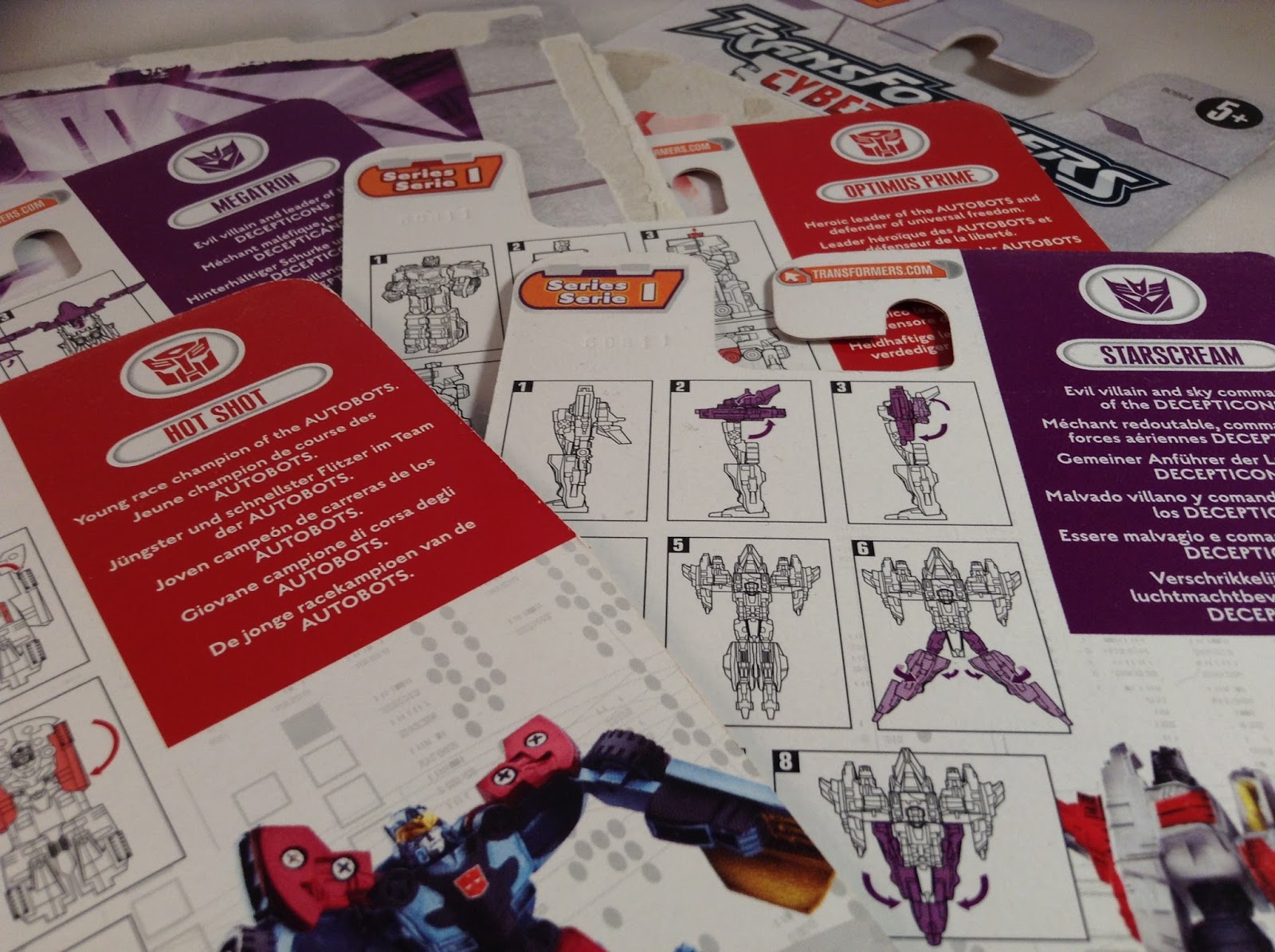
It is the year 2005. Transformers Cybertron graces toy shelves and television screens and I could be paying it a lot more attention. Thundercracker and Vector Prime are ok, but aren’t doing it for me anywhere near as much as Energon’s previous picks. I’m a bit burned out on TFs; do we really need another new Optimus Prime? But one day coming home from school, I find my dad has got me shrunken versions of Hot Shot and Optimus. I could suddenly take a different tack with my Transformers habit as I was introduced to the Legends Class. 

The Beginning


Far from the first small scale figures to grace Transformers, they were however the first made to emulate the much larger, more expensive main characters of the line. 12-year-old collects-too-many-things-under-£5 me is instantly hooked. My eyes open. Instead of chucking three quid at [Trading Card Brand of Choice This Week] I could chuck it at Transformers? The things I’d really want to spend money on but can’t bring myself to like enough to part with long-saved multiple fivers? Providence. Pure blessings from the collectables gods. A mission (still ongoing) starts. I could actually “collect” some TFs and collect them I did. (But if you know of anyone with a MISB Series 4 black legs Optimus, could you hook a brother up?)


Being there for the genesis of what is now a Transformers assortment staple has allowed me to take a good long look down the years that make up the history of this often-overlooked price-point. I love Legends… Or Legions, whatever you want to call them now. The point is – pocket money TFs are wonderful; when they slid under the threshold of what you might call pocket money. Back at the start with “Series 1” of the “Legends of Cybertron”, I got my hands on a quartet of main characters which in their fully realised forms would have cost me around £140 for the princely sum of £12. I never wanted big Megatron or Starscream anyway, but with the gates to a promised land of a “complete” small-scale TF collection opened before me, how could I say no to their diminutive counterparts? I could sample larger designs I wasn’t sure about or quickly get my hands on representations of characters I knew I wanted. All without costing me much in terms of cash or space. Some even replicated their Planet Key gimmicks and had more than four points of articulation, but most importantly they were unique new toys that gave you a flavour of something that was inaccessible. And lo, on through the four “series” (more simply “waves”) Cybertron had to offer I snapped up almost each release in timely fashion and mostly from the same shop. Looking back, that feels like quite a feat for someone not constantly plugged in to internet news about releases and sightings. Not that that wouldn’t have helped with getting hold of the last few…


After failing to uphold my vow of completing a collection of the Cybertron Legends by the time they disapparated from shelves, a fallow period followed as Classics repackaged Cybertron releases and only offered new repaints of these to Toys ‘R’ Us, a store that remains an hour’s pilgrimage away. Some years later I managed to get hold of a Leo Prime from the line but as it stood at the time I wouldn’t get my hands on more little guys until 2007’s Movie line. Much negative emotion exists around the live-action films ranging from indifference to outright bile but to have been 14 and been in the position to see the build up towards the first of m’Bay’s efforts was simply intoxicating. As soon as toys hit Woolworth’s I had to have something to take home and so I once again took up the torch of Legends mania with the help of Barricade and yes, managed to get every single-packed £3 bugger there was and some twin packs besides.


Pictured: Needless Excess


While the day I finally saw the film remains the most excited collection of hours in my life, the Legends toys didn’t operate on this higher vibration. If I was going to look back and place a not-so-shiny ribbon on the worst Legends assortment of the lot, it would certainly be awarded to 2007’s Series 7 to 9. I mean, have you seen Jazz? And I ended up with two of that thing… To be fair, the challenge of translating the already untranslatable movie designs to toys let alone ones this simple was clearly difficult for Hasbro, so while you can scoff at Starscream, I think it’s possible to cut them some slack. This was after all, the first Movie Legends rodeo. We’ll be seeing a fair few better ones.


Hound, Jazz and G2 Megatron, Best of the Bunch?


Following the movie’s success, 2008’s Universe was a bit of a blowout. New product was pushed out there quick and repaints from older lines lay abundant in both regular and exclusive releases. Abandoning the previous “Series” identifier which I quite liked for some reason, the first wave of Universe Legends was made of three Cybertron repaints, the first widely available pocket G1 characters of the class. But then Onslaught was an all grey SWAT truck so… 2 out of 3 ain’t bad I guess? Whatever qualms anyone had about the integrity of the first wave as a solid foundation for the line were blown out of the water with the arrival of wave 2. All new sculpts, two ’84 Autobot Cars and a G2 muscleman? Nothing’s come close since and this point may well exist as the eternal zenith of the Legends Class. But man, the waves after didn’t exactly drop things down far. 


Offering some ensmallened Animated bots but best of all, a slick new selection of G1 Minibots, the price-point came into its own. Simultaneously giving good pocket content but also bots that were fine to fill out those appropriately tiny gaps in your Classics shelf. Just a shame that the final wave Universe had to offer remains the only one I’ve never seen hide nor hair of and I know full well why…


Testicles Not Included


Midway through 2009 anything really cool that was left for Universe to tease you with was suddenly bulldozed out of sight by the resurgence of the Bay Merch Machine generating unjust hype for Revenge of The Fallen. Hindsight is a wonderful thing but back then I firmly believed the film would be rightfully immense and when it came to the Legends figures – inexplicably rolling out with two waves at once – I ate them up. Clearly lessons were learned after 2007’s efforts and the ROTF Legends remain some of the best out there. Bumblebee was a genuine surprise, providing the exact kind of simple fun the size class was made for. I… might have bought a few of his repaints… 


But not only in-movie characters were featured, as was delightfully true of the wider ROTF line, new characters and original designs colourfully fleshed out the ranks. Tankor is probably the figurehead of toy-only Legends and he even got a story in the UK comic, beating up bots who were in reality 3 times his size! But wait, there’s more! Mild gimmickry beyond Cybertron’s smattering of fold-out weapons entered the fray thanks to combination. You could stick Jetfire on Optimus’ back in a totally undocumented and mostly awkward move! And then Devastator reared his ugly head not very far off the floor in the form of a 7-pack boxset to deliver what was possibly the best experience of the class up to that point. It was almost like you could have a self-contained play pattern at this small scale…


Much in the way the first movie was followed, 2010’s understatedly untitled Transformers (not all of them had Hunt For The Decepticons stickers on) was rife with repaints and this time I did not partake in most. I wish I had. By the time the second-year refresh of Reveal The Shield had delivered sublime G1 stylings, I had amassed a grand total of 3 2010 Legends. Two brand new non-combining Constructicons which prove highlights to this day and an incongruous Sandstorm from Universe’s Beachcomber. It’s my belief that 2010/11 offered the pinnacle of anything Transformers among its small plethora of separate lines and the RTS Legends only go further to reinforce this state of mind. Only a single wave but a solid set of diverse G1 names. A fitting high to end the Legends Class on as here is where we part company with the price-point as we’ve come to know it and usher in the Legion…


Dark of The Moon shook up the pocket bot scene in a big way. Finally offering a more diverse play pattern based on the smaller scale, the £3 (at this point £5) bots of old we’re joined by a downgrading of the Scout class and various playsets, a move which I always felt should have been acted upon earlier. How good would a Universe Ark with bonus Skywarp have been? Thus, Cyberverse was born. Essentially a subline of its own within the Transformers framework, it would outlast DOTM and become the benchmark for the cheapest TF line-ups for the next three years. Not only a greater diversity was brought to the fore with DOTM though, as this was another chance to get the movie designs done right at this scale. Third time’s the charm rings true here. Long standing characters like Bumblebee and Starscream were given properly accurate renditions while the likes of Optimus and Ironhide made gains to better scale and pose with their rightfully smaller brethren.


If Legions were like Deluxes then the new Commander Class was the Voyager equivalent and it worked well; it wasn’t a substitute for the now dead Scout Class but it worked well. Also, while seeing the conceptual appeal of playsets, I didn’t invest in any. Most were only to be found at that faraway Shangri-La of Toys ‘R’ Us unless you wanted a heavily reduced Ark. I didn’t. I did however come to be the repentant owner of a version of Optimus’ trailer. Essentially a mess of panels on hinges that could approximate a base or some kind of Power Loader, it wasn’t anything to write home about and certainly wasn’t substantial enough to provide a sense of setting for the smaller figures.


Once the world seemed to suddenly grow very tired with DOTM, Prime toys finally and to absolutely no fanfare or prior warning arrived on shelves. Bearing the Cyberverse mantle once more this assortment of Legions and Commanders seemed to make some improvements. Highlights such as the almost insanely posable Cliffjumper and totally kibble-free Megatron made a lot more people sit up and take notice of what the smaller scale had to offer. As a plus, each figure also had at least one 3mm port to allow their small weapons to be used. Did I forget to mention that was true for DOTM too? While this added playability, I always felt the lack of accessories lent a kind of purity to the previous Legends and this was sullied. The figures were already small enough, now kids had to keep track of guns for them too? Initially Legion weapons were mostly the same mold, limited to strawberry or blackcurrant jelly flavour depending on allegiance but later waves brought some zing with more citrus flavours. Cyberverse was possibly at its height here though was set to continue for one more push as Prime gained a sequel in Beast Hunters.


Mostly the same line as its predecessor, BH offered some superficial enhancements. Solid metallic weapons were included, Commanders even had firing missiles and more closely resembled the ghost of the Scout Class. The odd but sometimes visually striking feature of Prime’s Commanders having translucent torsos to work with light gimmicks on playsets was dropped to allow for (somehow) better looking figures. Beast Hunters’ general theme of grand retooling of the previous year’s figures carried over here too, improving many of the more lacklustre toys with the addition of missile launchers or Mad Max spikitude. Lovely. 


While releases like the only Shockwave to grace UK shores or his out-of-left-field retool, Bludgeon rode the high points of the line, the very top spot was left for one more (seemingly the last) foray into small scale combining. Abominus was an excellent – if slightly stunted – homage heavy piece assembled sporadically over the course of three waves. Woe betide you if you skipped on wave 1’s Twinstrike. Not because it was Abominus’ left arm but because it was a genuinely great little figure, as each of the five Predacons and their arguably more intriguing repaints were. Good then, for the line to end in an incandescence of interest as what followed was merely a charred husk of what had come before.


Assorted Oddities


The second half of 2014 essentially saw the smaller scale die. Cyberverse was no more and for the longest time the only Legion releases available were reworked RTS figures and some dreadful Age of Extinction Dinobots born of BH Predacons. I only got one AOE Legends figure, a Prime Knock Out repaint in Stinger. Pretty underwhelming, but not as much as the line in total. No tiny Drifts or Crosshairs were to be had, the only movie-esque Optimus was an ill-fitting ROTF repaint, and Strafe didn’t even have two heads. Say what you like about The Encheapening that AOE brought about across the length and breadth of TF merchandise, at least you could get One Step Changers of all the characters as they appeared on screen. Age of Extinction indeed.


In this dark time for dreams of Legends collections, I lost most of my attachment to the price-point. Nothing was on offer to entice me back in to the fold, not really even 2015’s RID releases. Yes, the Legion Class at least was back properly. 3mm hands and ports were retained but all weaponry was dropped. It’s nice to have back-compatibility but I felt that a lot of the draw for the size class was lost to me. Not only were a lot of the figures seemingly smaller than average (possibly due to the illusory effects of minimalist packaging) but they now cost more than twice the price of ten years previously. £7 was simply too much for me to throw at figures barely pushing 2 inches. Perhaps with the accounting of inflation, that’s about right, but as long as I hold dear the memory of those halcyon days of Cybertron’s Legends, it will always leave a bad taste in my mouth. That said, I have tried to reignite my love for the class once so dear to my pockets, but even interesting repaints like Ultra Magnus or Ratchet have so far left me cold. Is this the end of my love affair with the smaller scale?


Probably not as it turns out. After getting my hands on a couple of Generations themed Legions from the venerable RTS molds, I’d like to hold out a bit of hope for the Legion. Ultra Magnus and Cliffjumper, despite being versions of figures I already own twice over (thanks to rare previous Generations offerings) are without doubt what the doctor ordered. If we could see a return to cheapy lil’ G1 themed guys, I think I’d be set. Just don’t skip the Ark and Skywarp eh? At time of writing that’s honestly all a pipe dream. With figures for The Last Knight set to rush in from The Bay in a few months, we are set to receive a revamped Legion Class which I will look to in mild anticipation. At least until I see how bloody expensive they are in Tesco’s for myself. Maybe until then I can console my empty pockets and delve into the huge wealth of figures still untouched in these twelve years since the legend began. I’m just going to have to put up with a lot of repaints aren’t I? Ah well, it comes with the territory.


Follow Ben on Twitter @Waspshot23

Wednesday, 11 January 2017

Sensorimotor Master - Finding value in auto-morph gimmicks and one step transformations


- Leigh Gregurke


With the act of the transformation so integral to the transforming robot experience it is little wonder that auto-morph toys, 1 step transformations, spring loaded auto mechanisms and all of their engineered brethren are seen as outsiders. Forever identified as a gimmick and rarely considered great designs they are however a regular attendee on the transformers time line recently finding a revival in Hasbro's new approach to more accessible designs and play pattern transformations. There has been that association of simple, the inclination that they deny the viewer the traditional pleasure of the transformation process and an assertion that they reduce some of the value by taking away our interaction. I remember as a child a distinct memory of a friends parent scoffing at my knock off Twin Twist, "It's not even... educational without the transformation."

They were wrong, I am just 25 years late with my explanation why.


The importance of play can be seen in its capacity to promote learning and development of cognition (the processes of gaining understanding through experience, action and thought) . With play comes inner or shared social dialogue, imagination and self talking through problems and decisions, it builds pathways and promotes new language and understandings. Russian psychiatrist Len S. Vygotsky's research on play and cognitive development was a big influence on my thoughts and practice as an educator and artist. Despite his primary focus on play with a focus on imagination rather than object interaction there is still tremendous relevance. “...As in the focus of a magnifying glass, play contains all developmental tendencies in a condensed form; in play it is as though the child were trying to jump above the level of his normal behavior” (1967, 16).  Play becomes a vessel in which we build our experiences and understandings, it is a pathway to new knowledge.


The process of play is underpinned by experimentation and inherit rules that are both followed, broken and re-established, a formative transformation process it is a combination of physical and mental efforts. Play I think is pivotal in developing an understanding of the object and understanding symbolism and representation. Vygotsky notes, “Play is a transitional stage in this direction. At that critical moment when a stick i.e., an object becomes a pivot for severing the meaning of horse from a real horse, one of the basic psychological structures determining the child’s relationship to reality is radically altered” (1967, 12). As toys for development there of course is the representational element, does this car represent a car or is it a car? can it be something else through play?  This understanding is further built upon through the act of play and in particular the learners interaction in the transformative process. The physical aspect of transformation is a way of developing an understanding of change, does this still have the same value if the learner however is removed somewhat from that change through auto-morph mechanisms?


Constructionist learning theory suggests it has tremendous value and sees that knowledge gathered by the learner themselves as having raised potential to be more widely understood and transferable than information presented from another in an educator/expert role. This model presents the learner as a scientist whom observes, builds knowledge through experimentation and their own experiences, a theory built on concepts presented by Piaget the Swiss
psychologist whom also has been profoundly influential in Educational Psychology. The observation theory suggests the importance of social demonstration, social learning through viewing another do a task, a model performing an act or demonstration. I know it could appear a stretch but when I let that Jumpstarter go or when a Battlecharger scoots awkwardly across my table and changes.... it is a demonstration, a performance, it is the task of transformation being carried out by another, in this case the carefully engineered toy that I initiated. I find that rather than dismiss the process as finished, rather than feel I have seen the act and there is nothing more to explore I want to know how it works. I want to test it again and watch it slowly. I want to be a scientist and through observation understand the mechanics. Play becomes an experience of learning in this moment.


Recently purchasing a Rescue Bots figure for my daughter I found myself fascinated by its one step transformation. At first I just did the motion and paid no mind to the moving pieces, assuming it only had a few complex parts I judged prematurely that little depth was to be found. Instead I began feeling the movements in my hand as I triggered the motion, I realised it was multiple parts and tensions at work. I observed closely as a hinged joint in turn pushed elements aside while itself sliding downwards creating motion for other parts. My daughter experienced the situation slightly backwards, as one of her first experiences with transforming toys it was interesting yet not remarkable. As she however started to experiment with more complex non auto-morph toys she recognized the difference and I think also the magic of very direct cause and effect. 

It was fascinating to observe what aforementioned theorist Piaget's 'Sensorimotor Stages' of development in action. Observing her demonstrate what he identified as 'Tertiary Circular Reactions', Piaget's suggested stage of experimentation of different techniques to attain responses and 'Early Representation Thought' as she created an understanding of the toy as a representation of a truck but also not a truck and also as an object of play that when manipulated represents a figure. Piaget placed emphasis on the way in which young minds build an understanding that an object has a permanence and continues to exist outside of simply seeing it. To watch her play and know that one form did not mean the other no longer existed was fascinating, an understanding had been created that a very simple physical motion would restore or dismiss one of the forms but it still remained, hidden but accessible through a now learned action.


While obviously hard to recall my own formative experiences I can trace paths to certain memories. Whilst I never owned a Twin-Twist or Top-Spin during my life I owned a steady flow of knock-offs that I tested the limits of regularly. I never saw their feature as a gimmick, it was to me a piece of genuine wonder watching them sometimes... and often not change in front of my eyes, bouncing up on their sides or flipping. It was such a kinetic experience and I tried it on different surfaces, downhill, uphill, tiled laundries and carpeted lounge-rooms and even sand pits and grassy yards. The process was both observation and interaction. The focus on early development might seem to validate these figures as early educational tools and promote relegation to being lesser valued to collectors/adult purchasers, does their value extend further than developmental benefits though?


The Beast Wars basic line contained a number of spring loaded toys that are sized perfectly to be played with one hand. Like a mindfulness exercise they are somewhat relaxing to observe rarely providing challenge, their simplicity in final design though obfuscates a mastery of execution and elegance. They suffer no consequences of their spring loaded mechanism that forebears were constrained with. Well past my early stages of cognitive development these experiences were a pleasant series of reminders but also past the initial surprise pop were highly presentable action figures capable of a plethora of dynamic and interesting poses, no longer hobbled in simplicity like their ancestors they made the most of Hasbro's embrace of ball joints adding extended user creativity and play past the functional automatic mechanism.


A line that would later see the spring loaded heritage passed on was the brilliant Animated Activators line. More ball jointed wonders with no limit of articulation and in some cases designs that eclipsed the silhouettes of their up-sized line entries. Activators Bumblebee scales perfectly with the rest of the mainline and I would suggest is a better all round toy than the deluxe class barely hampered by his automated mechanism. What this line also gave was a genuine pop, there is something entirely kinetic and cartoon like about pressing a integrated red button to kick-start the process. Much like the aforementioned curiosity of engineering I find myself now still fascinated by the motion, wishing I could see it slowed down. Even now I still engage that scientist element of my brain, fascinated and interested in observation and understanding.


From both an educational and development platform to one of valuing surprise, engineering and the value of simple play, I like to believe that automated and semi automated transformations should be considered as worthy of examination from both collectors and learners young and old alike. The process that we might consider lost, the transformation still occurs just in a different way and we are still a key agent in that process. To be able to go back with my gained knowledge now and justify the value of play to a detractor... I wonder now if that formative experience had any role in my passions for building an understanding of the value of play. Play at the time then and still now assisted in understanding the viewpoints expressed. Play allows us a space to experiment with our understandings of both the socio-cultural world and the physical world. It promotes us to re-create roles in a creative space that over time transfers, underpinning our everyday behaviors (Fisher 2011 , 348).

Next time you pull back one of those Battle-chargers hoping dearly its aged mechanism will work try not to think of the process as finished once you let go, ask yourself, how does it work, what is going on and why? Be a scientist and try different methods, understand how it works, make it work and reflect on your observations. Play. 


Follow Leigh on Twitter @AmbushThem


Fisher, K., Hirsh-Pasek, K., Golinkoff, R. M., Singer, D. G., and Berk, L. (2011). Playing around in school: Implications for learning and educational policy. In A. D. Pellegrini (Ed.) Oxford Handbook of the Development of Play. Oxford University Press.
Piaget, J. (1983). Piaget's theory. In P. Mussen (Ed.) Handbook of Child Psychology. 4th edition. Vol. 1. New York: Wiley.

Vygotsky, Lev S. (1967). Play and Its Role in the Mental Development of the Child. Soviet Psychology. Translated by Scripta Technica,

Wednesday, 4 January 2017

Ogling Oddbots

- mantis nine nines


This is truly the best of times for Transformer fans. Billion dollar movies, multiple TV shows, a  constant flow of new toys at retail and even a thriving unofficial collectors market. 
All of this is made possible by the strength and consistency of the brand itself. A focused and unified brand, carefully curated into an almost singular look. Transformers are universally humanoid in shape, with two arms, two legs and all the personality quirks of our neighbors, coworkers and selves. Iconic. Relatable. BORING.


Cash and Bandit (Select Convertors)

In the beginning the Transformers pantheon was much more chaotic and varied. Micro change, Diaclone, Macross, Dorvack, all of these existed as their own properties. Megatron and Optimus Prime may be iconic rivals today but Convoy and Gun Robo were never destined to meet, they lived in entirely different universes.

Chosen to be a Transformer but still odd: The Mechabot from Toybox

My fandom dates back to this time, and thus I have always retained a taste for what I like to call the oddbot. 
Transforming cash registers, roulette wheel, pinball machines, binoculars, motorized boats, some oddbots are defined by their alt mode. Others are defined by having a strange and unique robot mode completely at odds with the cookie-cutter human shape we are now accustomed to.


F-16 Fighting Falcon (Unknown) Transforming Moth (LH Toys) and Sabrest (Rock Lords)

The variety of those early days was not confined to only the Hasbro transformers brand. One of my favorite lines, Select Converters, also brought together toys from a wide range of companies. Convertors shared many of the same properties that Hasbro did, but without the same fixation on human form. This led to a much more diverse collection of robot and vehicle designs. For example; both Select and Hasbro used the Mugen Caliber and Gazette from Dorvack but the completely non humanoid design of the Tulcas did not fit the Transformers aesthetic so it was dropped. This design only hit our shores as the Select Converter “Tanker”.


The Mugen Calibur (L) Gazzette (M) and Tulcas (R) from Special Armored Battalion Dorvack

What Could Have Been; Tanker (Select Convertors) 


While Tanker provides an excellent example of toy pruning by Hasbro, there were still some misfit molds that made it through. Ironhide/Ratchet in particular has all the characteristics of the oddbot. No head, strange industrial limbs, this design is quirky even for a mech suit. Why Hasbro included it we'll never know, but they made sure to get as far away as possible from the toy when it came time to cast the Sunbow cartoon.


Hard to believe the G1 box art (L) and the Sunbow animation model (R) depict the same character.


The redesigned Ironhide was always one of my favorite characters in the show and yet I still loved the toy. Whatever it looked like, it was fun and different as a plaything, and I never let show accuracy get in the way of a good time.
This is why I love these stupid-looking oddbots so much, the fun factor. Its hard to look at their squat, non-proportional designs and not smile. The alternate modes provide their own unique enjoyment. Some of them are fully functional roulette wheels, pinball machines, radios, capguns, anything a kid would enjoy playing with has an oddbot version out there somewhere.


It doesn't get more odd than the Marchon Mysterians!


My YouTube channel was founded with a mission of “rarely seen, never reviewed” and while I sometimes stray into the mainstream, my purpose remains the same. I want to provide the same smorgasbord of robot flavor that I enjoyed as a young fan to the current day. I never saw any reason why these varied designs shouldn't live together, and neither should you.
Many of you will not find the same fascination with these oddities that I do. Taste is subjective and I know mine tends to be in the minority among modern fans. I firmly believe that if you take the time to investigate some of these oddbots you will discover something new and wonderful.
Many are from anime or toylines that failed spectacularly but nonetheless feature brilliant designs. Who knows, perhaps one of you will discover inspiration that will lead to an entirely new Fandom 30 years from now. Break free from the narrow confines of humanoid robot design, there are so many possibilities to explore!

The Unique and Very Cool Sasuraiger Train Bot.


Follow Dan on Twitter @mantisninenines